
Linux for Tegra and Android (beta) on the CB302B: One architecture.
Every form factor.
Curve Reality separates compute, power, and I/O into a modular architecture. The same core hardware becomes a desktop workstation, a wearable system, or an embedded brain.
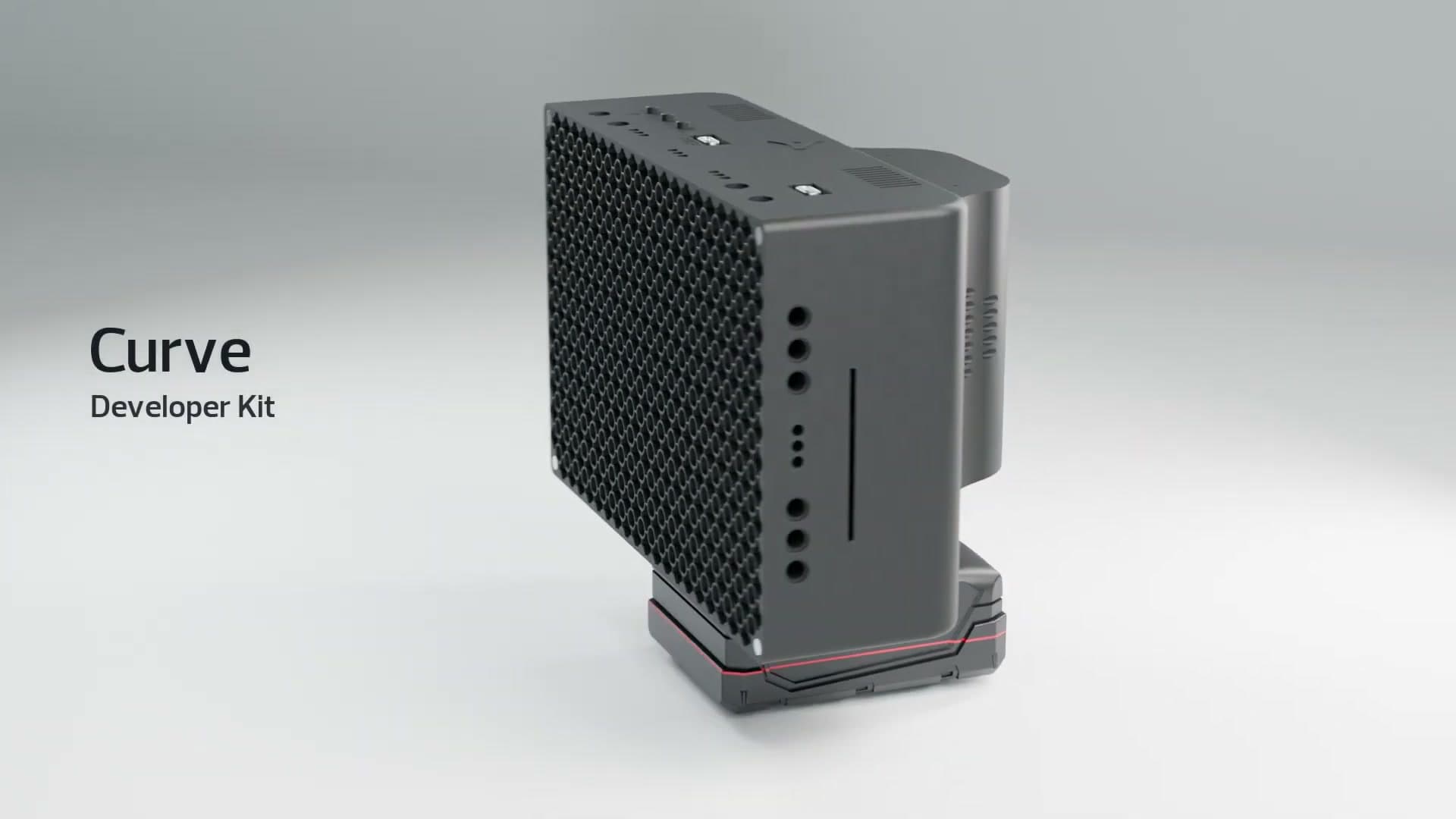
02 - The stack
Interfaces evolve.
The core persists.
Displays and applications change independently from the compute and I/O layers beneath them. That's what lets one board power a desktop, a robot, and a wearable system without redesign.
Applications
AI agents, games, robotics, industrial software, wearable interfaces
Interfaces
Monitors, AR glasses, VR headsets, sensors
I/O + Carrier Board
DisplayPort, USB, networking, storage, expansion
Compute + Power
NVIDIA Jetson, hot-swap batteries, thermal, field operation
L1–L2 = Curve hardware · L3–L4 = yours to define
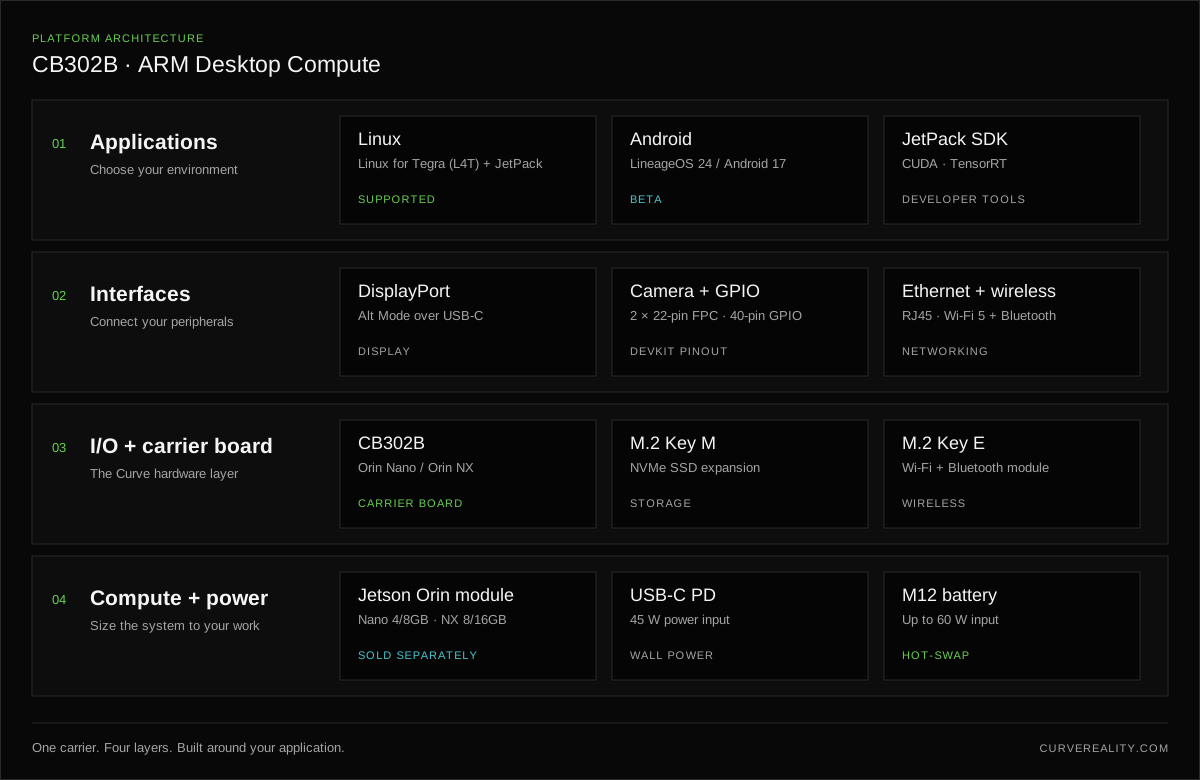
Platform architecture
CB302B · ARM Desktop Compute
Applications
Choose your environment
Linux
Linux for Tegra (L4T) + JetPack
Supported
Android
LineageOS 24 / Android 17
Beta
JetPack SDK
CUDA · TensorRT
Developer tools
Interfaces
Connect your peripherals
DisplayPort
Alt Mode over USB-C
Display
Camera + GPIO
2 × 22-pin FPC · 40-pin GPIO
Devkit pinout
Ethernet + wireless
RJ45 · Wi-Fi 5 + Bluetooth
Networking
I/O + carrier board
The Curve hardware layer
CB302B
Orin Nano / Orin NX
Carrier board
M.2 Key M
NVMe SSD expansion
Storage
M.2 Key E
Wi-Fi + Bluetooth module
Wireless
Compute + power
Size the system to your work
Jetson Orin module
Nano 4/8GB · NX 8/16GB
Sold separately
USB-C PD
45 W power input
Wall power
M12 battery
Up to 60 W input
Hot-swap
03 - Operational modes
One platform. Three configurations.
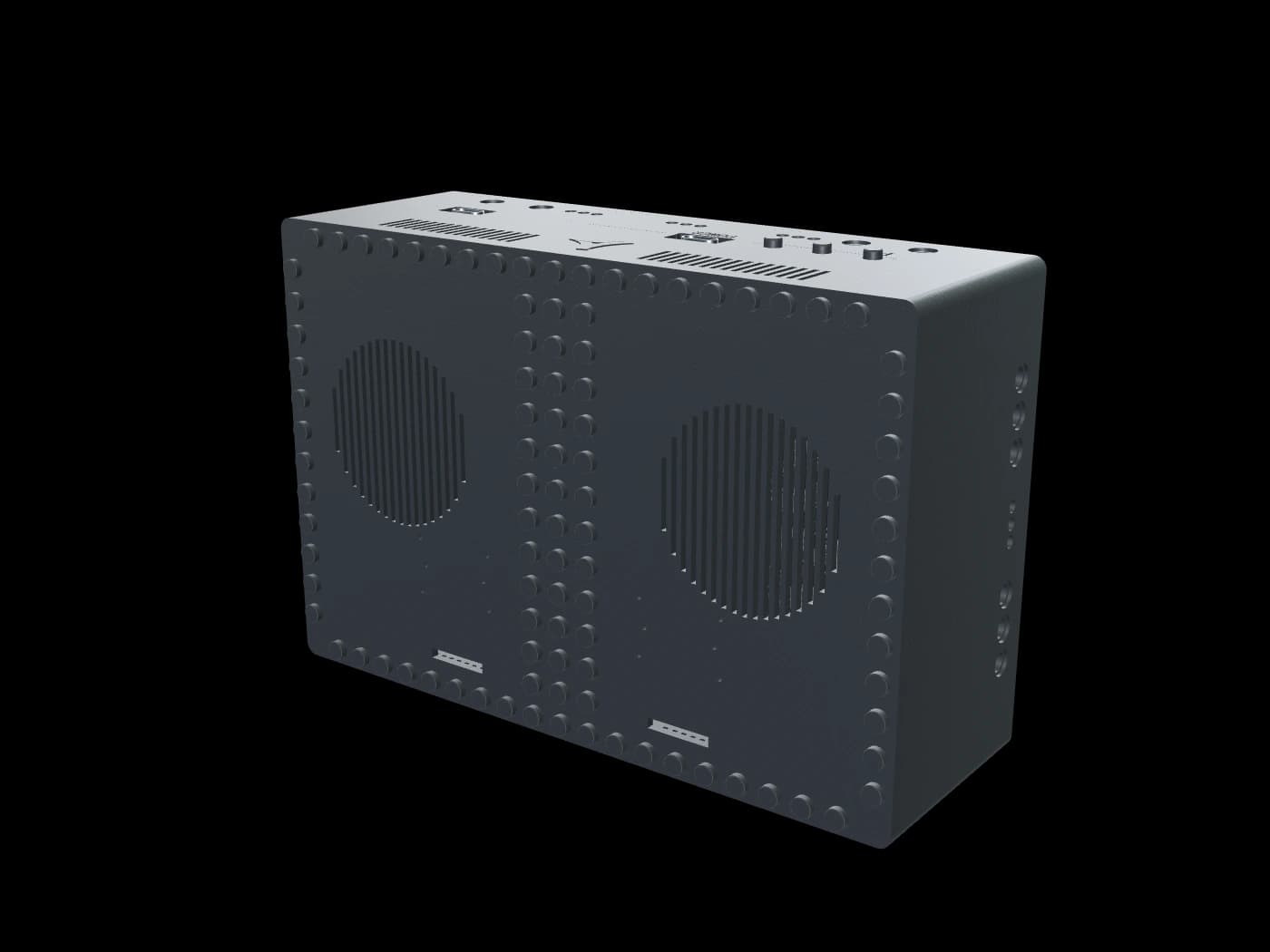
Connect to external monitors, keyboards, and peripherals for a portable workstation or lab setup.
Compact desktop assembly shown. The same carrier forms the core of each configuration.
04 - Modular by design
Every part replaceable.
Nothing disposable.
01
Compute
CB302B supports Orin Nano / Orin NX with native Linux for Tegra (L4T) and native LineageOS 24 / Android 17 (beta). DisplayPort over USB-C connects your desktop display. Upgrade the module, keep the system.
02
Storage
M.2 NVMe on every carrier board. Configure capacity per application, from lightweight deployments to large local datasets and models.
03
Power
Hot-swappable Milwaukee M12 batteries. Continuous operation, field-serviceable power, no proprietary battery lock-in.
05 - Who builds on it
Built for teams shipping real systems.
AI product teams
Portable or embedded AI systems that need modular compute and power.
Robotics & edge
AI-accelerated compute in mobile, battery-powered, or field environments.
Industrial & defense
Rugged, modular systems for training, teleoperation, inspection, or field deployment.
Research labs
Prototyping next-generation intelligent hardware and context-aware edge platforms.
Curve Reality - Rev 2026.04
Designed in New Zealand